






BUY LOCALLY. ACT GLOBALLY.
IP-Transit - AS8218 & AS6461 from a single source
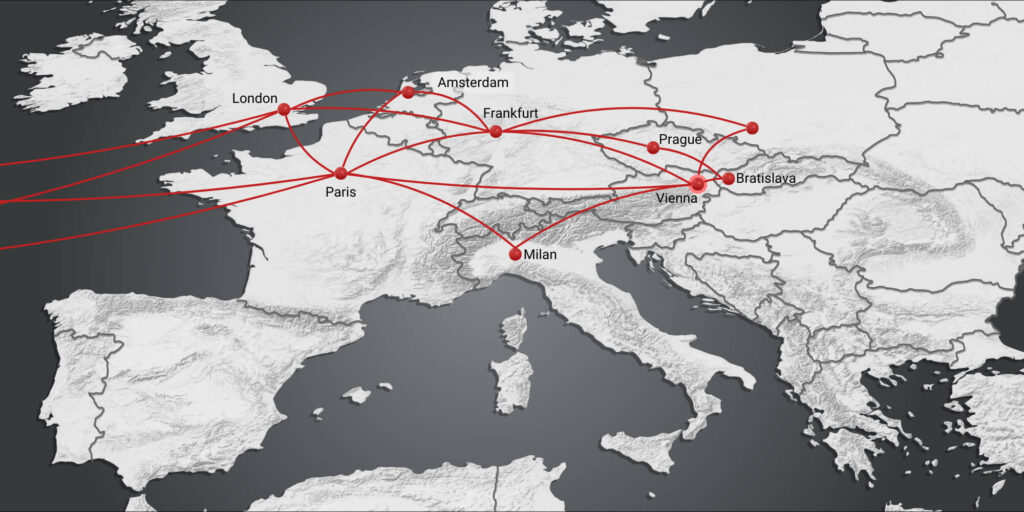
Frankfurt, London, Paris, Milan or Prague - only a few hops away.
What is IP transit?
IP Transit (Internet Protocol Transit) is a commercial service that connects a proprietary network (e.g. that of a company or ISP) to the global Internet by routing it over a major provider's backbone network so that traffic can flow to and from any destination on the Internet without the customer having to establish direct connections to every other network.
Essentially, the customer „rents“ access to the entire Internet, ensuring fast, reliable and scalable global connectivity.
What types are there?
- Single-Homed: Connection and therefore access only via a single provider. This is cheaper, but less fail-safe.
- Multi-Homed: Connection via multiple transit providers for greater redundancy. The Border Gateway Protocol (BGP) is used to exchange route and reachability information between the autonomous systems (AS) in order to find the most efficient path for data traffic.
How IP-Transit works:
- Forward data traffic: A transit provider (often a so-called "upstream provider" or "Tier 1 ISP") provides your network with bandwidth and routing information (using BGP).
- Full internet access: This makes your network part of the global Internet, enabling you to exchange data with other networks worldwide.
- BGP routing: The customer usually operates its own Autonomous System (AS) and receives a complete BGP routing table from the transit provider, which contains all accessible network routes.
Premium IP transit with global best performance.
IP transit includes:
- Customer handover port: 1 Gbit / 10 Gbit / 100 Gbit Ethernet
- BGP Communities & Looking Glass
-
Transfer options in Vienna:
VIX (University), VIX2 (Digital Realty) and VIX3 (NTT) - Customer access to APAMS for equipment and bandwidth monitoring
- Network Operation Center: 24 hours, 365 days a year
AS8218 & AS6461 in facts & figures:
- More than 1 terrabit of European traffic IP transit
- More than 600 gigabits of transatlantic capacity
- More than 800 peerings and 200 operators worldwide
- IPv4 & IPv6 + MPLS at the most important peering locations
- Our most important peering exchanges: Frankfurt, Paris, London, Brussels, Amsterdam, Vienna, Zurich, Madrid, Tokyo, New York, Palo Alto, Chicago, Ashburn
Why it is important
- Scalability and efficiency: It is an efficient way to achieve a huge global reach instead of connecting to thousands of individual networks.
- Reliability: Transit providers use their extensive backbones and peering agreements to ensure robust and uninterrupted connectivity.
- Cost efficiency: For many companies and ISPs, it is more economical to buy IP transit than to establish their own peering relationships with all the major players.
Why IP transit from upstreamNet
With IP-Transit via AS8218 and AS6461 (Zayo), our customers gain access to two of the world's leading Internet backbones. The result: faster loading times, lower latencies, high stability and maximum accessibility - both nationally and internationally.
The parallel use of both networks ensures maximum reliability. If one path fails or is busy, the other automatically takes over - without interruption. Your applications, cloud services and customer access remain available at all times.
For you this means reliable enterprise-level quality, optimum performance for business-critical applications and an Internet connection you can rely on at all times - ideal for cloud services, international locations and business-critical applications.
More performance. More safety. More range.
With upstreamNet into the Global Internet
Details on the AS6461 at https://zayoeurope.com/network/
See for yourself and contact us for a trial! Use us as your local contact and benefit from international players - everything from a single source!
Testimonials
What our customers say
Customers appreciate upstreamNet's reliable and efficient services and the direct contact with a personal contact person.
We are happy to take time for you and answer your questions in a face-to-face your questions in a virtual meeting.
The path to the data center seems complex, especially if your own requirements are not clearly defined and several contacts are involved. We provide you with professional and non-binding advice. We will help you where you need support and save you from pitfalls on the way to the data center.
Our values
Your advantages with upstreamNet
"Availability, security, flexibility and handshake quality are our core values at upstreamNet. That's why every customer is assigned a personal contact who takes care of all their concerns."
FAQ
Frequently asked questions & answers
What is AS8218 and what advantages does it offer?
AS8218 is the autonomous system (AS) of upstreamNet together with our French partner and part of the international network of Zayo Europe with a focus on Western and Central Europe. It enables highly available connections and stable data transmission between the most important European regions and networks.
What is AS6461 and how does it complement AS8218?
AS6461 is another autonomous system that focuses its activities primarily on North America and Western Europe. The focus is also on the expansion of bandwidths and metro networks. While AS8218 has been established in Western and Central Europe for decades, AS6461 offers additional reach and stability for connections outside Europe. This combination offers enormous opportunities for our customers.
What is the Vienna Internet Exchange (VIX)?
The Vienna Internet Exchange (VIX) is one of the central Internet hubs in Vienna where Internet providers and networks can exchange data directly with each other. A connection to the VIX means lower latency times, higher speeds and better stability, as the data traffic does not have to be routed via several intermediate stations. upstreamNet is directly connected to all three VIX nodes, ensuring fast and reliable connections.
Why is a connection to peering locations such as VIX important?
Peering describes the direct exchange of data traffic between two networks without the involvement of a third-party provider. At peering locations such as the VIX, these connections are optimized, resulting in lower latency times, higher speeds and a better user experience.
How does upstreamNet guarantee high bandwidths?
Redundant dark fiber rings in Vienna, path-redundant international connections to the various Internet nodes such as Frankfurt, Milan and Paris, but above all the fact that capacities are maintained to compensate for service outages or disruptions ensure that customers receive the quality they expect from upstreamNet in the area of IP connectivity & IP transit. The individual concept for each customer optimizes the price/performance ratio. During operation, the local NOC and the expertise of the backbone administrators in Paris - where DDoS is also managed - work together to ensure that customers are supported around the clock. Especially in times of DDoS attacks and increasing cybercrime, this is another reason to rely on upstreamNet's IP.
What is dark fiber?
Dark fiber refers to unused fiber optic lines that companies can use exclusively. They enable dedicated, highly secure and extremely fast data transmission without multiple users having to share the bandwidth. At upstreamNet, dark fiber connects the RDC and ODC21 for maximum stability and high availability.
What is the Border Gateway Protocol (BGP) and how does it work?
The Border Gateway Protocol (BGP) is a routing protocol that ensures that data packets are routed via the best available route between networks. With upstreamNet, BGP enables dynamic switching to alternative routes in the event of a fault if configured accordingly, ensuring reliability and therefore availability.
How does BGP differ from TCP/IP? And why does BGP offer more security than conventional solutions?
TCP/IP (Transmission Control Protocol/Internet Protocol) is the basic protocol for data transmission on the Internet, but is static in terms of route selection. If a connection fails, data cannot be automatically rerouted, which leads to interruptions. BGP (Border Gateway Protocol) offers more security and flexibility here: it analyzes data traffic in real time and automatically switches to alternative routes if a connection fails. This ensures continuous availability without failures.
Why use upstreamNet to enter the global worlds of the world-wide-web?
At upstreamNet, BGP is supplemented by additional measures such as Arbor TMS Mitigation, which can filter harmful data traffic such as DDoS attacks at an international level. In combination with the autonomous AS8218 and AS6461 systems, the direct connection to nodes such as the Vienna Internet Exchange (VIX, Digital Realty, NTT) and the resulting „free“ capacities to Frankfurt, Milan and Paris, upstreamNet offers significantly more service security and protection than comparable national providers. The potential and possibilities of a leading global provider network (AS6461), an established Western and Central European player (AS8218) paired with customer-oriented technicians and access via direct contact persons of an Austrian GmbH is our unique selling point.
Please contact us.
upstreamNet Communications GmbH
Ruckergasse 30-32
1120 Vienna
Austria
- +43 5 01 8218-0
- +43 5 01 8218-5225
- office@upstreamNet.at